Ditto Music Review for Independent Artists: What to Check Before You Sign Up
How this review was evaluated: This article focuses on the decision points independent artists usually care about before signup: royalty control, platform reach, pricing clarity, app usability, public reviews, and support visibility. All core claims are checked against Ditto Music’s live site pages.
If you are comparing music distributors as an independent artist, the smartest move is not to start with hype. Start with the things that affect your work after release day: ownership, royalties, platform reach, payout access, analytics, and support when something goes wrong. Ditto Music’s current live site makes a very direct promise here: it says artists can keep 100% of royalties, release to 150+ platforms, and use a wider support and app ecosystem to manage the process.
That does not automatically mean Ditto is the right fit for every artist. What it does mean is that the brand is positioning itself around independence with control, not around giving your career away in exchange for access. If that is your working style, this is the right place to start checking.
Control and ownership come first
.jpg)
Ditto Music positions itself around wide platform reach, artist control, and keeping 100% of royalties.
The first signal worth taking seriously is Ditto’s repeated claim that artists can keep 100% of your royalties. On the homepage, Ditto also says artists should keep complete control of their careers and avoid unfair deals. On the pricing page, the platform repeats that it does not take commission on royalties and that artists keep every penny they earn. For independent artists, that is not a nice extra. That is the core trust question.
The second check is practical, not emotional: what are you actually signing up for at plan level? Ditto’s live pricing page shows Starter for 1 artist, Pro for 2 artists, and Labels for 3+ artists. That matters if you release under multiple names, run a side project, or want label-style admin later.
There is also a very important distinction many newer artists miss. Distribution royalties and publishing royalties are not presented as the same thing. Ditto’s publishing route says artists can claim up to 20% in extra royalties, while the publishing page itself explains that publishing collection is a separate route for additional royalty recovery and sync opportunities. So if you are comparing value, do not blur “basic distribution” and “extra royalty collection” into one basket.
Platform reach matters, but only if it matches your real release goals
Ditto’s live pages consistently say artists can release to 150+ platforms. The homepage names major destinations like Spotify, Apple Music, TikTok, Amazon, YouTube, Instagram, Facebook, Deezer, and Tidal, while the reviews and pricing pages repeat the 150+ platform claim. That is a strong sign that Ditto is built for broad mainstream digital reach rather than a narrow niche release setup.
.jpg)
Ditto Music highlights broad platform reach across major streaming, download, and social platforms.
Still, a big number by itself is not the real reason this matters. What matters is whether the platforms you actually care about are clearly named, and on Ditto’s live site they are. That lowers the guesswork for indie artists who want wide distribution without manually piecing together separate store relationships.
The pricing page also adds workflow value beyond pure reach. Ditto says Starter includes free pre-save SmartLinks, in-depth analytics, automatic split royalty payments, instant Spotify verification, and playlist submission access. For a self-directed artist, those are the kinds of operational tools that can matter more than marketing slogans.
Analytics, payouts, and the app are where the fit becomes real
A lot of distributors sound similar until you ask what happens after the release is live. Ditto’s pricing and homepage pages put real emphasis on in-depth analytics, fast royalty payouts, automatic split royalty payments, and app-based access to stats and withdrawals. That is a useful signal because it points to day-to-day workflow, not just front-end promises.
.jpg)
The Ditto Music App highlights real-time stats, playlist tracking, audience insights, and royalty withdrawals in one mobile workflow.
On the app page, Ditto says The Ditto Music App lets artists access real-time streaming stats, track playlist placements, understand listener demographics, check and withdraw royalties, and share or monitor releases from a phone. The homepage repeats that the app can be used for real-time stats, playlist features, audience analytics, promotions, and quick royalty withdrawals.
This is usually the point where independent artists decide whether a platform actually fits them. If your ideal setup is to stay hands-on, monitor performance yourself, manage splits, and cash out without needing someone to hold your hand each week, Ditto’s current feature set looks aligned with that model. If you want a distributor to function more like a personal manager, these tools are helpful, but they are not the same thing as full-service career management.
Social proof is useful, but read it the right way
Ditto’s reviews page currently shows 2 million+ artists worldwide, 150+ music platforms, 100% rights & royalties, and 4.2 out of 5 on Trustpilot based on 4,929 reviews.
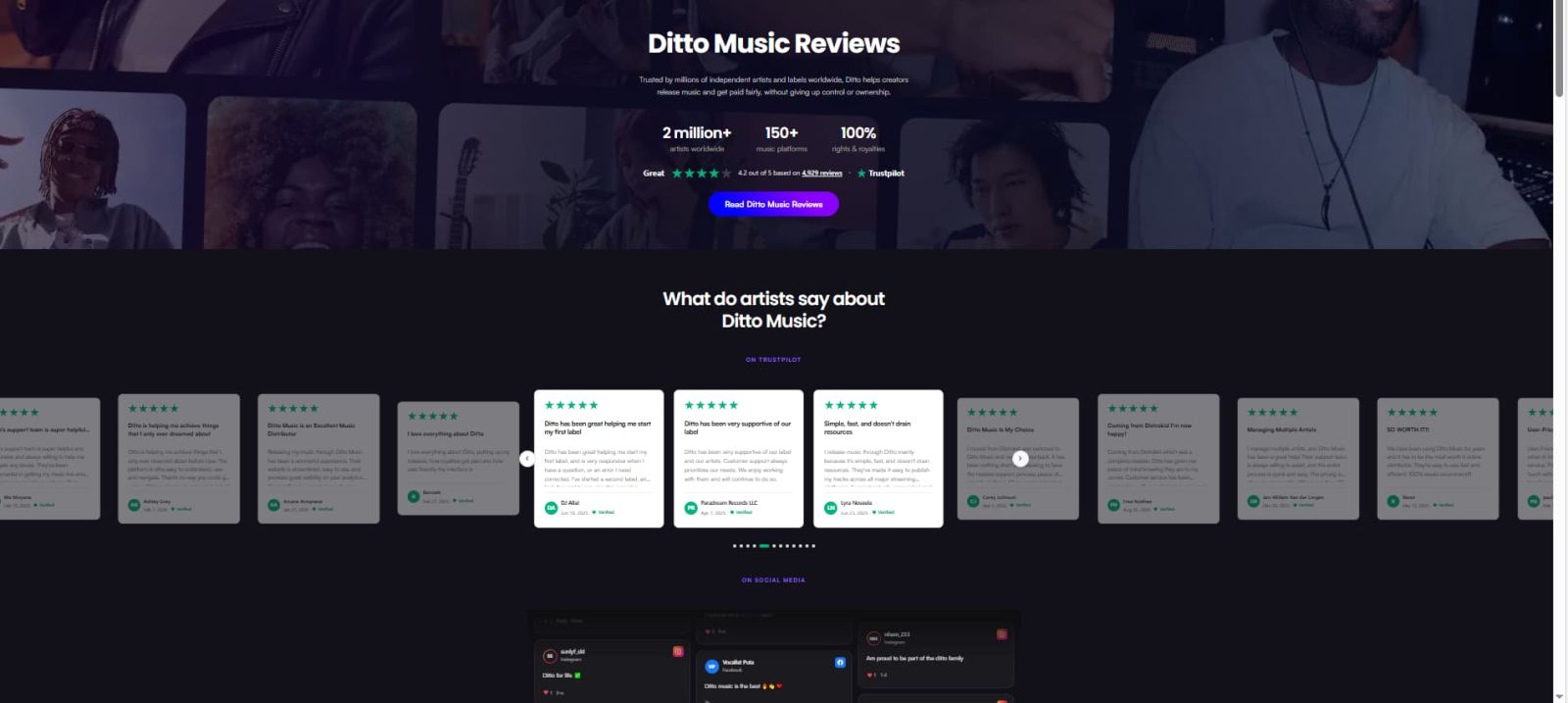
Ditto Music combines visible trust metrics with real artist review snippets, making it easier to evaluate recurring themes beyond star ratings.
That is a stronger trust package than a generic “artists love us” statement because it combines scale, product positioning, and visible third-party review presence on the same page.
More importantly, the examples displayed on that page are not all saying the exact same thing. Several recent verified review snippets highlight responsive support, easy navigation, useful analytics visibility, and straightforward royalty handling. Those are the kinds of signals commercial-investigation readers should care about most, because they relate directly to everyday distributor friction.
That said, reviews should help you spot patterns, not make the whole decision for you. The strongest use of this page is not “the stars look good.” It is “do the review themes line up with the problems I actually need solved?” On Ditto’s live review page, support responsiveness, usability, analytics, and payouts clearly show up as recurring themes.
Support structure is one of Ditto’s better trust signals
Ditto’s support hub is more structured than a basic help page. It clearly surfaces categories for Frequently Asked Questions, The Basics, Uploading Music, Making Edits, Getting Paid, Your Account, Ditto Music App, Music Platforms, Copyright & Metadata, Fraud & Licensing, and even Thinking of leaving?. That breadth matters because it shows Ditto expects users to manage more than just upload-and-forget releases.
.jpg) Ditto Music’s support hub makes key help routes visible up front, from release basics and edits to payouts, account help, and app support.
Ditto Music’s support hub makes key help routes visible up front, from release basics and edits to payouts, account help, and app support.
When you click deeper, the structure becomes even more useful. The Getting Paid collection includes articles on withdrawals, payout methods, split royalties, pending royalties, transfer fees, withdrawal timing, and payment differences. The Uploading Music section covers release builder issues, artwork format, audio format, featured artists, lyrics, genres, release times, and even AI-generated music questions. Making Edits covers artist-name changes, release-date changes, store additions, and post-upload edit scenarios.
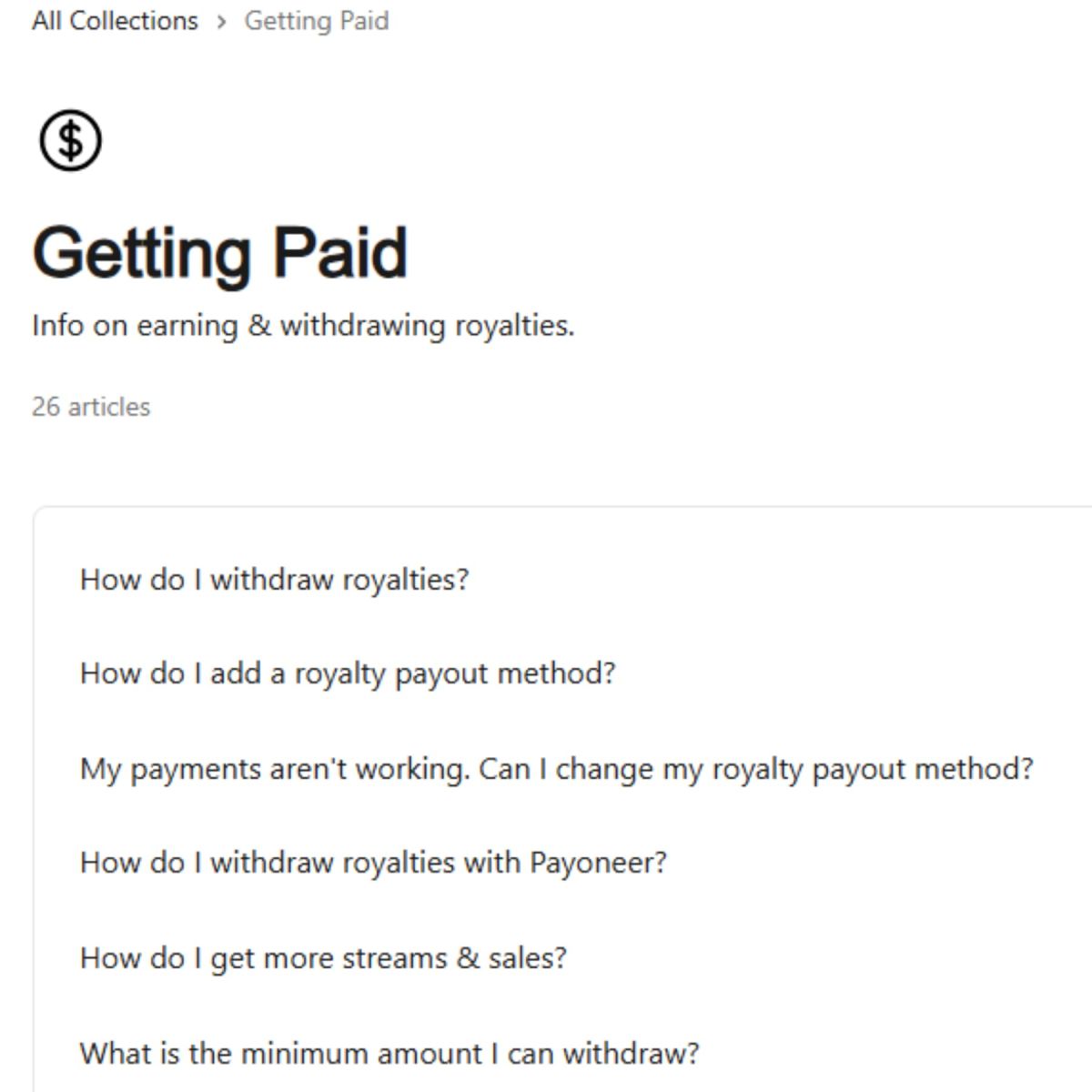
Ditto’s Getting Paid section shows that payout setup, royalty withdrawals, split payments, and earnings questions are documented before signup.
For new artists, The Basics is especially reassuring because it includes getting-started questions like cost, rights ownership, multi-artist use, analytics detail, release status meanings, and whether Ditto offers a free trial. That does not guarantee every support experience will be perfect, but it is a stronger trust signal than sending artists into a vague contact form with no visible knowledge base behind it.
Ditto may be a strong fit for: solo artists, self-managed acts, small teams, and labels that want broad platform reach, 100% of distribution royalties, visible support routes, and app-based stats.
Ditto may be less ideal for: artists who mainly want high-touch management, deep hand-holding, or a distributor to run the process for them.
So, is Ditto Music a good fit for independent artists?
Ditto looks like a credible fit for artists who want control first, not dependency first. The current live site consistently emphasizes keeping 100% of royalties, maintaining rights ownership, reaching 150+ platforms, using self-serve analytics and payouts, and accessing a fairly visible support structure. For a genuinely independent artist, that is a coherent value proposition.
It looks less naturally suited to artists who want someone else to run the whole process for them. Ditto’s strongest signals are about tools, access, visibility, and platform-led control. That is great if you want to stay in charge. It is less compelling if your main need is high-touch management without doing much yourself.
The smartest next step is simple: check the trust signals and support routes first, then compare Ditto Music’s current plans to see whether the platform matches your working style.
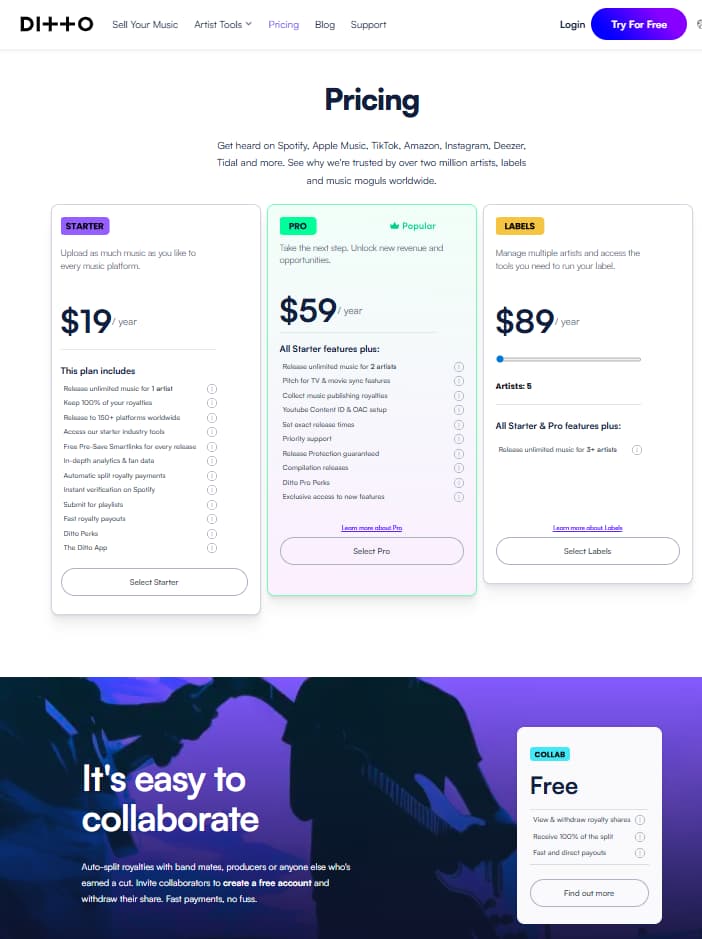
Ditto’s pricing page helps independent artists compare plans, core features, and collaboration tools before deciding whether the platform fits their working style.