Ditto Music for Independent Artists: Distribution, Royalties, Promotion and Growth Tools Explained
Editorial note: This article is based on Ditto Music’s live homepage, pricing, publishing, promotion, app, labels, and reviews pages at the time of writing. If affiliate links are added in the future, I may earn a commission at no extra cost to you.
How this review was evaluated: This article focuses on the decision points independent artists usually care about most before signing up, including distribution reach, royalty control, monetization routes, launch tools, app usability, scale options, and public trust signals. Core claims are checked against Ditto Music’s live site pages.
If you are an independent artist, the real question is not whether Ditto can get your music online. Its live site already makes that part clear. The bigger question is whether Ditto’s full stack matches the stage you are in right now: distribution, royalty collection, promotion, mobile tracking, or multi-artist scale.
That is what makes Ditto more interesting than a one-note distributor. On the current site, the platform is not presented as just “upload your songs and wait.” It is presented as a route map: release music widely, keep your distribution royalties, unlock extra publishing income, push releases with promo tools, track performance in the app, and move up to Pro or Labels when your setup gets bigger.
Start with the foundation: distribution and control
Ditto’s homepage and pricing page put the core pitch front and center: release unlimited music, distribute to 150+ platforms, and keep 100% of your royalties. For independent artists, that combination matters because it answers the first three objections quickly: can I release widely, do I keep control, and does the platform skim my distribution income? Ditto’s current live messaging is built to say yes to all three.
The entry point is also straightforward. The pricing page frames the core plan around one artist, unlimited releases, 150+ platforms, starter tools, analytics, split royalty payments, Spotify verification, playlists, fast payouts, Perks, and app access. That makes Ditto feel less like a bare upload utility and more like a distribution-first operating layer for self-managed artists.
For a first release, that is usually the right place to begin. You do not need to buy the entire ecosystem on day one. You need a reliable base that gets your music out widely, keeps your rights and royalties intact, and gives you room to expand later. Ditto’s live site makes that “start simple, add more later” path easy to understand.
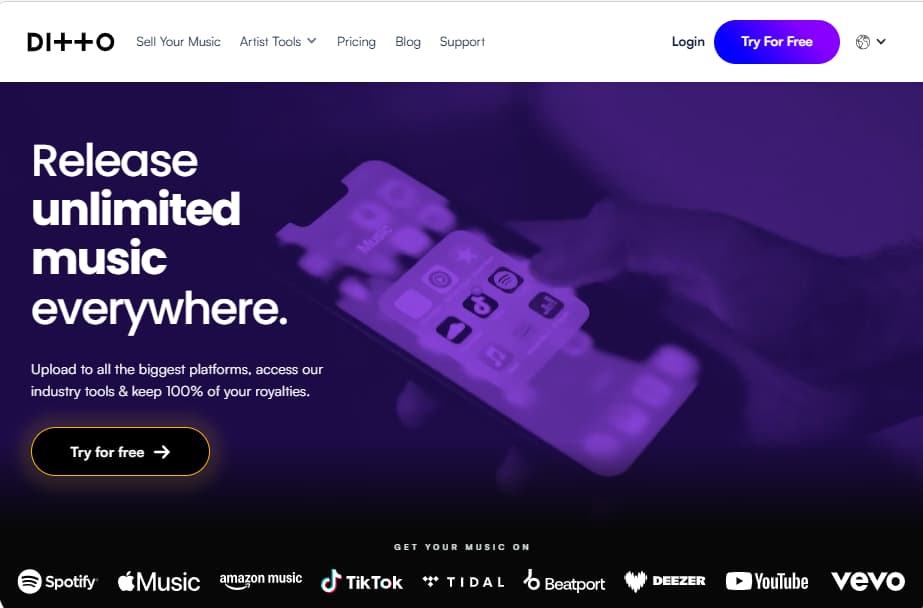
Ditto Music introduces its core offer around wide distribution, artist control, and keeping 100% of royalties.
Where the money expands: publishing, YouTube monetization, and sync
Once your music is live, Ditto’s stack starts branching into extra income routes. The clearest one is Music Publishing. Ditto’s publishing page says it will register your music for publishing royalties across the globe while you keep full ownership and copyright. The homepage and Pro messaging go further by framing publishing as a way to claim up to 20% in extra royalties that many artists may otherwise miss.
That matters because distribution income is only one part of the money picture. Ditto is clearly trying to move artists from “my song is out” to “am I collecting everything my song is earning?” That is a more useful commercial question, especially for artists who are starting to get consistent streams, radio play, live performances, or broader usage.
Then there is YouTube Content ID, which Ditto presents as a monetization and protection tool. Its Content ID page says artists can claim royalties whenever their music appears on YouTube, and the YouTube Music route says Content ID is available on Pro and Labels plans. Ditto Pro also includes sync pitching for TV, film, games, and ads, which turns Ditto from a distributor into something closer to a growth platform for artists who already have music worth exploiting across more channels.
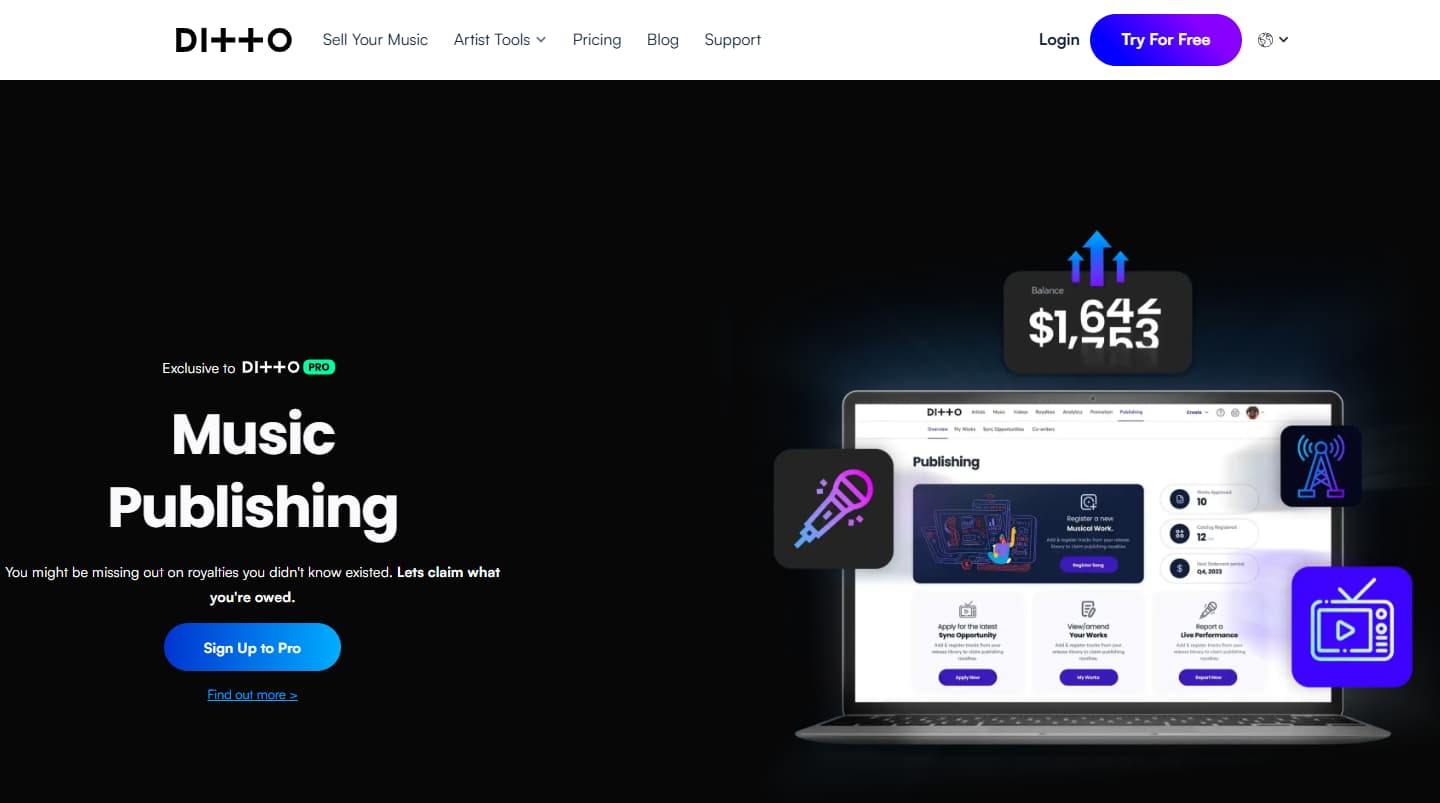
Ditto Music positions publishing as a route for artists to collect more of the royalties their music may already be generating.
Before release day, Ditto also gives you launch-ready tools
A good hub should not skip the boring-but-important prep work. Ditto’s Music Mastering page offers a free full-length preview of a mastered track, then a download for $5. The same page connects mastering directly back to release readiness by pointing artists toward Spotify, Apple Music, TikTok, and 150+ platforms once the track is finished.
That is useful for independent artists because it keeps a common pre-release job inside the same ecosystem. You do not have to treat mastering and distribution as two completely separate worlds if your goal is simply to finish a song and get it out with fewer handoffs.
Ditto’s Pre-Save SmartLinks sit in the same “ready the release” category. The pre-save route says artists can keep all important release links in one place and let fans opt in to email updates directly from free pre-save SmartLinks. The pricing page also lists free pre-save links as part of Ditto’s promotion toolkit. That makes SmartLinks less like a bonus widget and more like one of the standard launch assets artists should actually use.
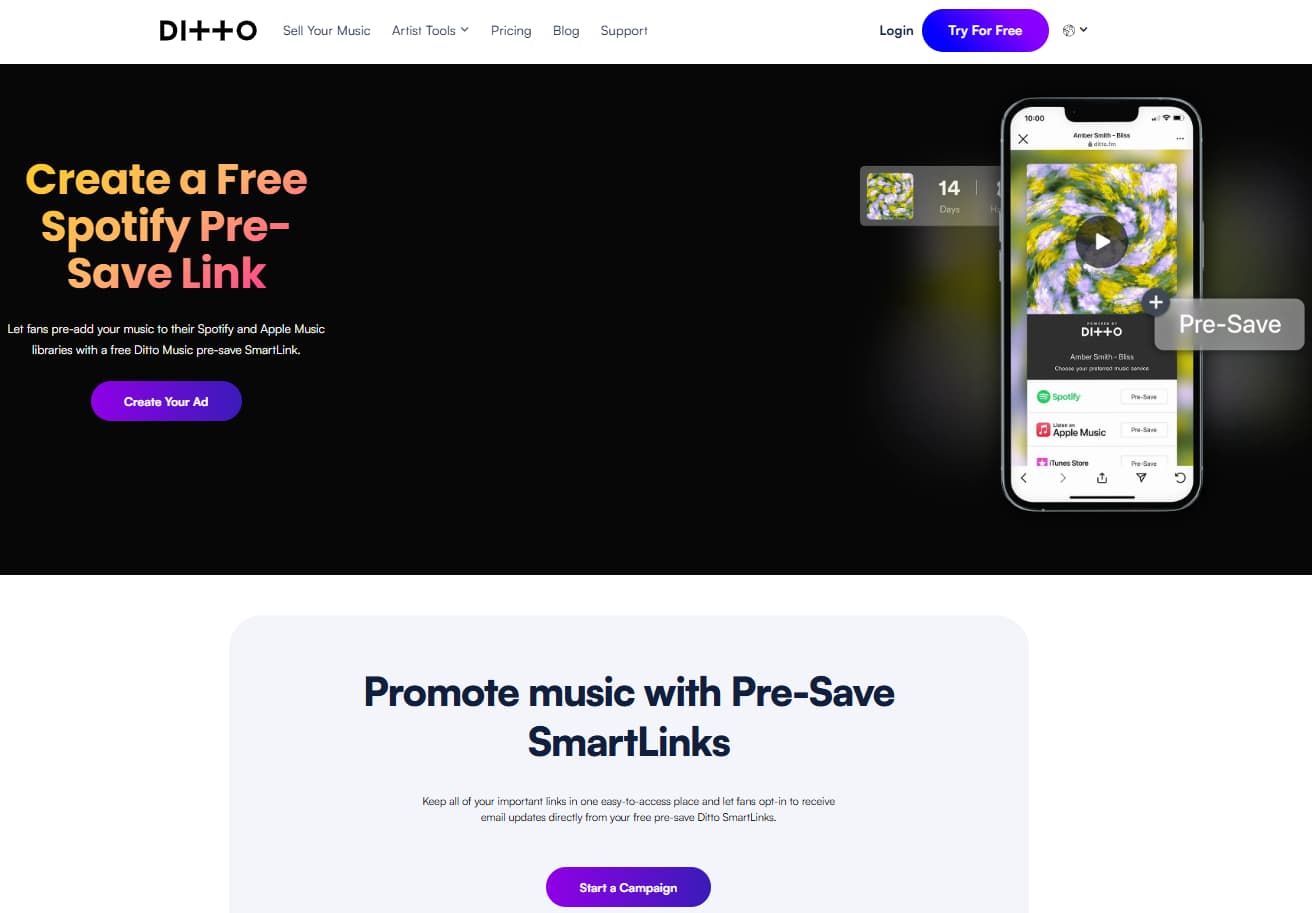
Ditto’s Pre-Save SmartLinks help artists collect key release links in one place and promote a song before launch day.
Promotion is where Ditto starts acting like a campaign partner
Ditto’s Music Promotion page is not subtle about the offer. It frames the route around playlisting, online press, social strategy, sponsored ads, and custom graphics, all wrapped into campaign formats managed by Ditto’s team. The page also describes 4–6 week campaigns, paid ad campaigns in Promo Plus, priority distro and support, and custom graphics and videos.
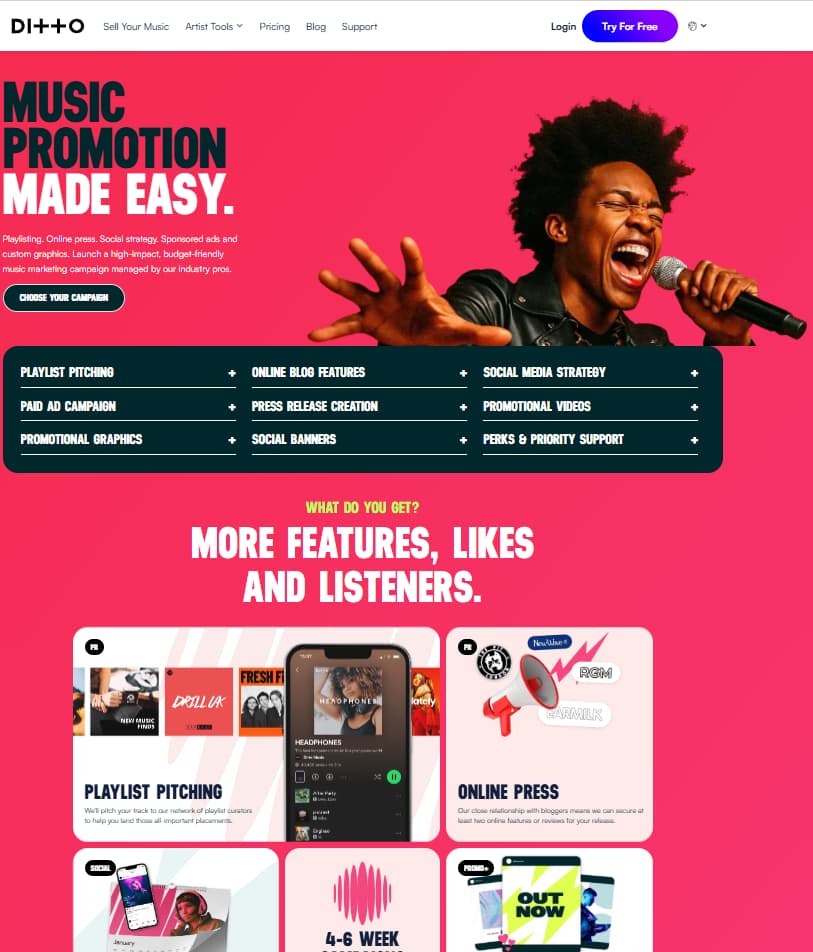
Ditto Music presents promotion as a managed campaign route, combining playlist pitching, press, social strategy, paid ads, and creative assets.
That matters because many artists do not fail at distribution. They fail in the quiet gap after release day, when the track is technically live but nothing is pushing listeners toward it. Ditto’s promo route is clearly meant for that stage: not “how do I upload?” but “how do I get traction once the upload is finished?”
The pricing page supports that same idea from another angle. It says Ditto will give artists free pre-save links and access to chart registration, promo campaigns, and advice content. So even when you are still comparing plans, Ditto is nudging you toward the idea that growth tools are part of the stack, not a separate afterthought.
The Ditto Music App makes the platform feel more usable day to day
The Ditto Music App is one of the clearest signals that Ditto wants to be used continuously, not only at upload time. Its app page says artists can track real-time performance across platforms and get paid on the go. It also highlights live streaming stats, playlist placement tracking, audience insights, and royalty withdrawals from a phone.
That is important for independent artists because the right platform is not just where you release. It is also where you check whether anything is working. If your workflow depends on fast visibility into streams, playlists, listeners, and cash-out status, the app becomes a genuine reason to stay inside the ecosystem.
This is one of the main dividing lines between “cheap distribution” and “operational platform.” Ditto’s live app messaging leans hard toward the second category.
.jpg)
The Ditto Music App combines real-time stats, playlist tracking, audience insights, and royalty withdrawals in one mobile workflow.
When you want to scale, Ditto starts separating into Pro and Labels
This is where Ditto’s ecosystem becomes more segmented. Ditto Pro is positioned as more than distribution, with a feature stack that includes unlimited distribution for two artists, sync pitching, publishing royalties, YouTube Content ID, timed releases, priority support, release protection, and Pro Perks. The Pro page also currently advertises 20% off your first year with code PRO20, which signals that Ditto is actively trying to move artists up the ladder once basic distribution is no longer enough.
Ditto Labels is the scale route for people managing more than one act. Its labels page highlights automatic royalty splits, direct artist payouts, pre-save links for every release, lyrics and credits uploads, and auto-release to new platforms. In other words, the product stops behaving like a single-artist tool and starts behaving like roster infrastructure.
If you are still in the early solo stage, you probably do not need every Pro or Labels feature immediately. But the fact that those routes already exist matters. It means you can start with distribution and still grow inside the same platform when your release schedule, catalog, collaborators, or artist roster becomes more demanding.
.jpg)
Ditto’s pricing page makes the step up from Starter to Pro and Labels easier to understand for artists who are starting to scale.
Trust proof matters, but the best next step is still stage-based
Ditto’s reviews page adds the broad trust layer: 2 million+ artists worldwide, 150+ music platforms, 100% rights & royalties, and 4.2 out of 5 based on 4,929 reviews on Trustpilot. Those numbers do not replace fit, but they do reinforce that Ditto is not positioning itself as a niche unknown.
The smarter takeaway is practical. If you are trying to get music out cleanly and keep your distribution money, start with the distribution and pricing routes. If you already have traction and want to recover more value, move toward publishing, Content ID, and sync. If your challenge is attention, go to pre-save links, promo, and the app. If your setup is getting bigger than one artist, compare Pro and Labels.
That is why Ditto works best when you treat it like a route map instead of a single feature. Explore the pricing page and the Ditto Music Reviews page first, then choose the part of the stack that matches your current release stage.
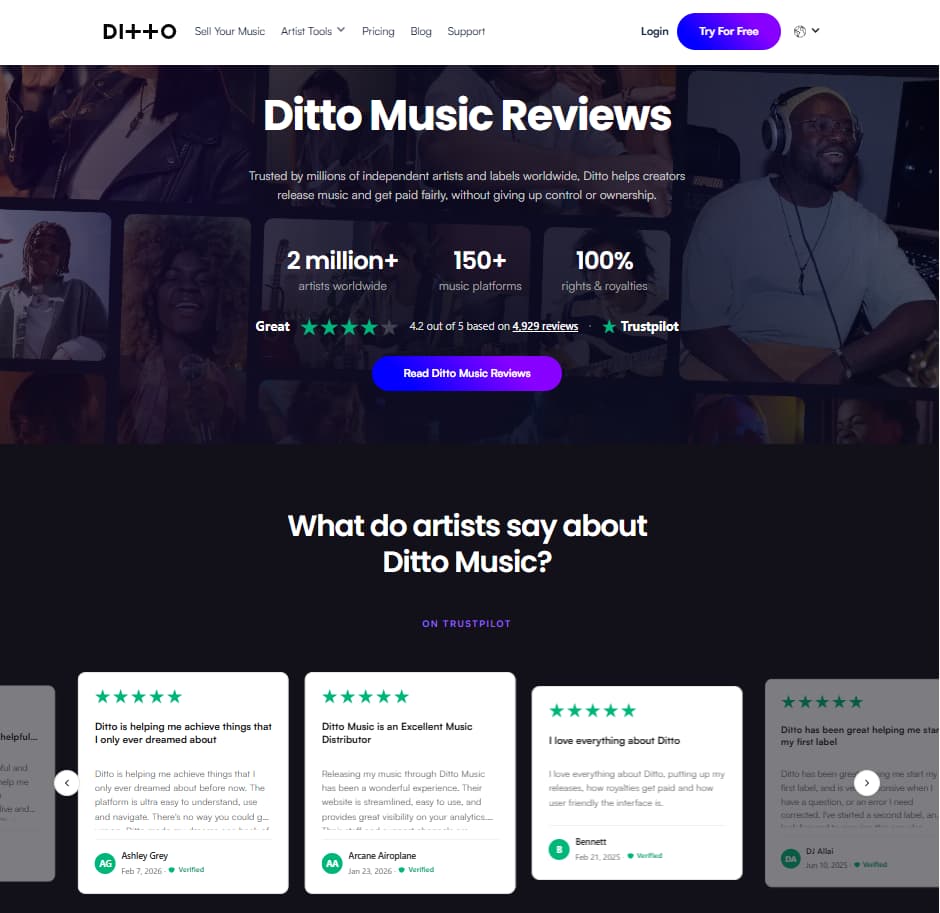 Ditto Music combines public trust metrics with real user reviews, making it easier for independent artists to evaluate both scale and day-to-day user experience.