Choose KuKirin G2 when you want a balanced 800W scooter that covers ordinary commuting, mixed pavement and longer leisure routes without carrying a second motor.
Its lower 26 ± 0.5 kg listed weight is the practical advantage you notice whenever storage is not at ground level.
Choose KuKirin G2 Master when the route repeatedly asks for more: sustained gradients, heavier combined load or stronger acceleration.
Two 1000W motors and a 52V 20.8Ah battery turn it into a performance platform, while its 41.5 ± 0.5 kg weight makes ground-level storage part of the decision.
 Reviewed by Nguyen Dinh · Last checked September 7, 2026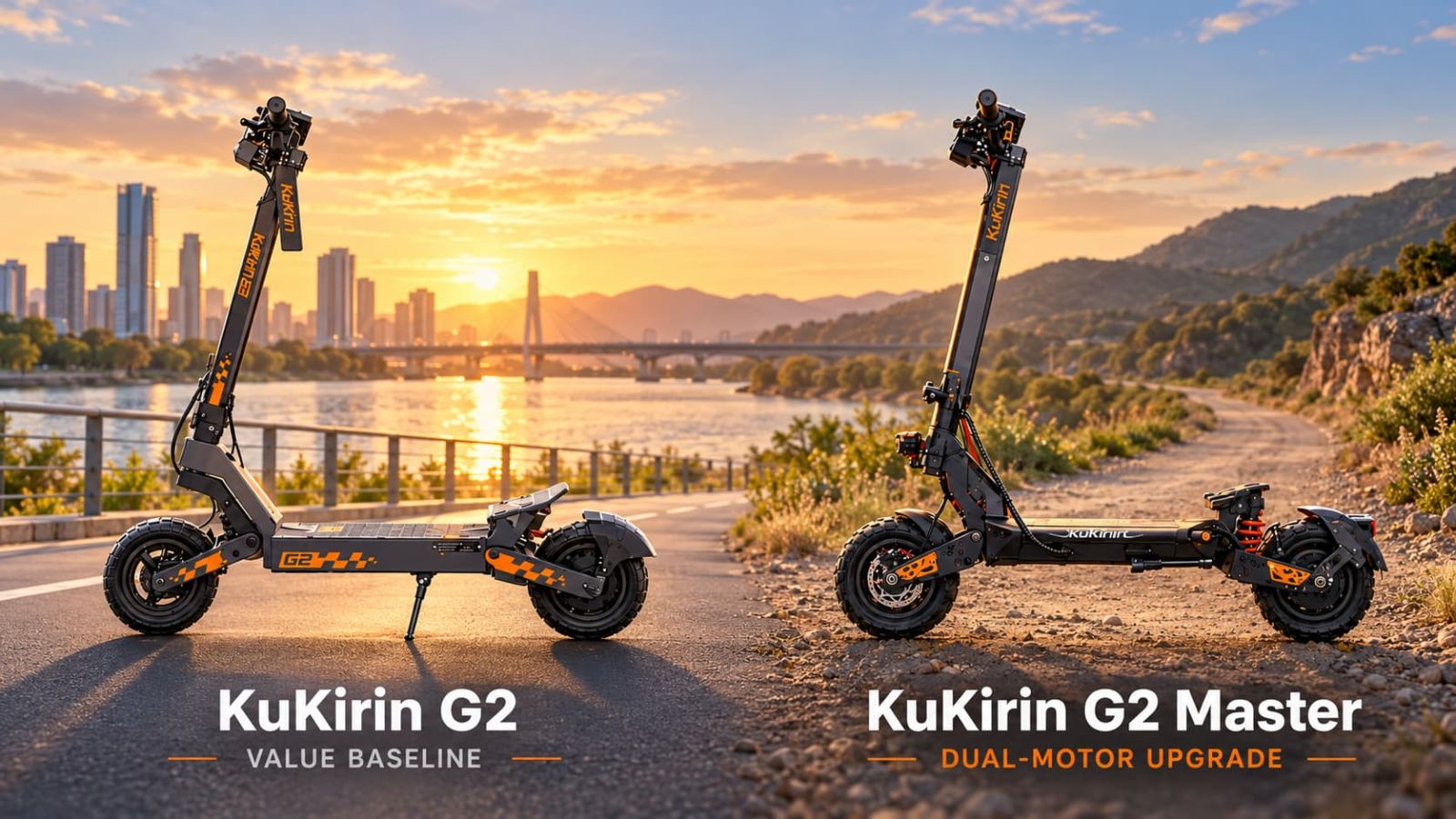
Quick Verdict: Balanced Ownership or Dual-Motor Reserve?
Buy KuKirin G2
Best for riders whose normal route fits an 800W rear motor and up to 55 km of listed range. It preserves useful suspension, pneumatic tires and folding storage while avoiding the Master’s extra drive hardware and mass.
Buy KuKirin G2 Master
Best for experienced riders who can name the recurring condition that needs two driven wheels: steeper sections, heavier loads or acceleration demands. Its value comes from available performance under resistance, not a larger number alone.
G2 is designed to cover more everyday routes with less ownership burden. G2 Master is designed to keep propulsion available when route resistance exposes the limit of one motor.
KuKirin G2 vs G2 Master at a Glance
Drive Architecture: Efficiency of One Motor vs Traction From Two
G2 concentrates propulsion at the rear through an 800W motor. That layout is enough when the route is mainly level or rolling and the rider values predictable energy use.
Fewer driven components also keep the platform closer to a manageable ownership baseline.
G2 Master splits propulsion across the front and rear with two 1000W motors. On a recurring climb or under heavier load, the second contact patch can contribute instead of asking one rear motor to carry every acceleration demand.
That is the Master’s strongest upsell: it removes a repeated bottleneck.
A flat route does not automatically reward the larger system. If one motor already maintains the needed pace, G2 converts less of the purchase into unused capability.
If speed loss on inclines or response under load is already a known frustration, G2 Master gives the upgrade a measurable job.
Battery and Range: Simpler Planning vs a Larger Performance Reserve
G2 pairs its 800W motor with a 48V 15Ah battery and lists up to 55 km. Its energy system is proportioned for buyers who want enough distance for commuting and leisure without carrying the Master’s larger battery-and-motor package.
G2 Master moves to 52V 20.8Ah and lists up to 70 km. The extra capacity supports longer routes, but it also feeds two motors when performance modes are used aggressively.
The range advantage is most valuable to riders who manage output rather than treating the maximum mode as the default.
Neither number is a guaranteed trip distance. Temperature, rider weight, wind, tire pressure, gradients and stop-start riding change consumption.
Plan around the longest normal charging gap and keep a reserve; do not size the purchase to a perfect-condition maximum.
Chassis and Control: Agility or a More Substantial Platform
G2’s 26 ± 0.5 kg listed weight makes it easier to roll through tight storage areas, reposition beside a desk or load with assistance.
The benefit is not that 26 kg is light; it is that the scooter asks less effort every time ownership requires movement without motor power.
G2 Master uses its 41.5 ± 0.5 kg structure to carry two motors and the larger battery.
That mass suits a performance platform intended to remain planted, but it changes low-speed handling and parking. Riders with a garage, lift or ground-floor storage receive more value than anyone facing stairs.
Both use 10-inch pneumatic off-road tires and suspension. The difference is what the chassis must support: G2 manages a balanced single-motor system, while G2 Master must keep a higher-output front-and-rear drive package usable.
Ownership: Folding Solves Shape, Not Mass
Both stems fold to reduce vertical space in storage or a suitable vehicle. For G2, that can support mixed commuting where the scooter occasionally needs repositioning.
For G2 Master, folding is mainly a garage-and-vehicle feature; 41.5 kg remains 41.5 kg after the hinge closes.
Charging also reflects their missions. The Master’s listed 10–11 hour charging time favors overnight routines and planned use.
G2’s smaller energy system better suits riders who need less route reserve. In either case, secure a dry charging location with enough ventilation and avoid planning daily use around last-minute top-ups.
Choose by the Situation
Mostly level commuting with occasional rough pavement: choose G2. Its motor, tires and suspension address the route without making dual-drive hardware the price of entry.
A repeated steep section or heavier combined load: choose G2 Master. Two driven wheels give the additional output a recurring purpose.
Storage involves a lift, narrow doorway or occasional vehicle loading: G2 is easier to manage. Measure the full path rather than comparing folded dimensions alone.
Long leisure routes with ground-level storage: G2 Master provides the larger listed energy reserve, provided the rider budgets range conservatively when using both motors.
Your first full-size performance scooter: G2 is the cleaner learning platform. Move to G2 Master when route evidence—not curiosity about top speed—justifies the extra response.
Route, Rider and Legal Compatibility
Both models list a 120 kg maximum load, but total load includes the rider and anything carried.
Staying below the headline number does not guarantee identical climbing, braking or range performance. The closer the combined load approaches the limit, the more valuable operating reserve becomes.
Check local vehicle classification, speed limits and permitted riding locations. The listed maximum speeds describe product capability, not permission to use that capability in public.
Protective equipment and braking distance deserve more attention as output rises.
For a broader hierarchy check, compare these two models with the Best KuKirin Electric Scooters guide.
Buyers focused on single-motor range can also read the KuKirin G2 Max review before moving to dual drive.
KuKirin G2: The Balanced Route Platform
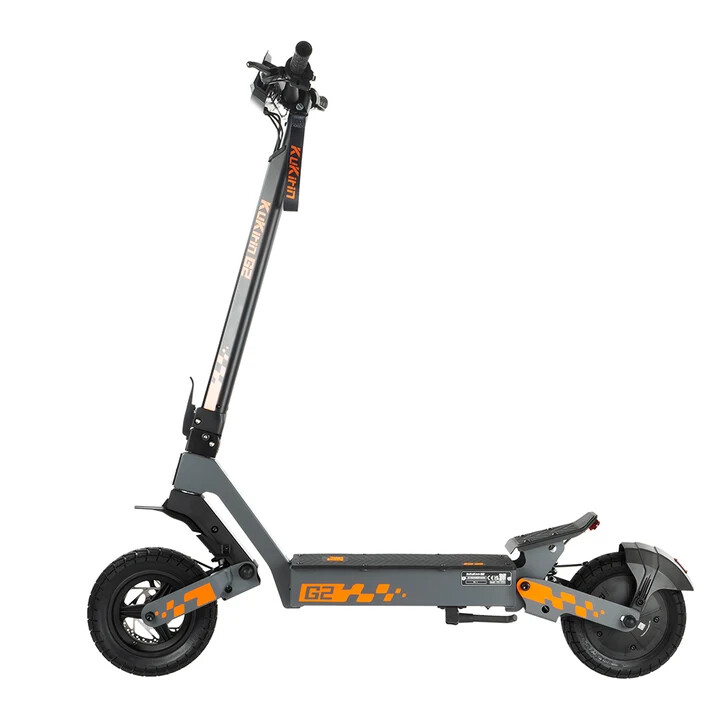
Hardware Without Excess
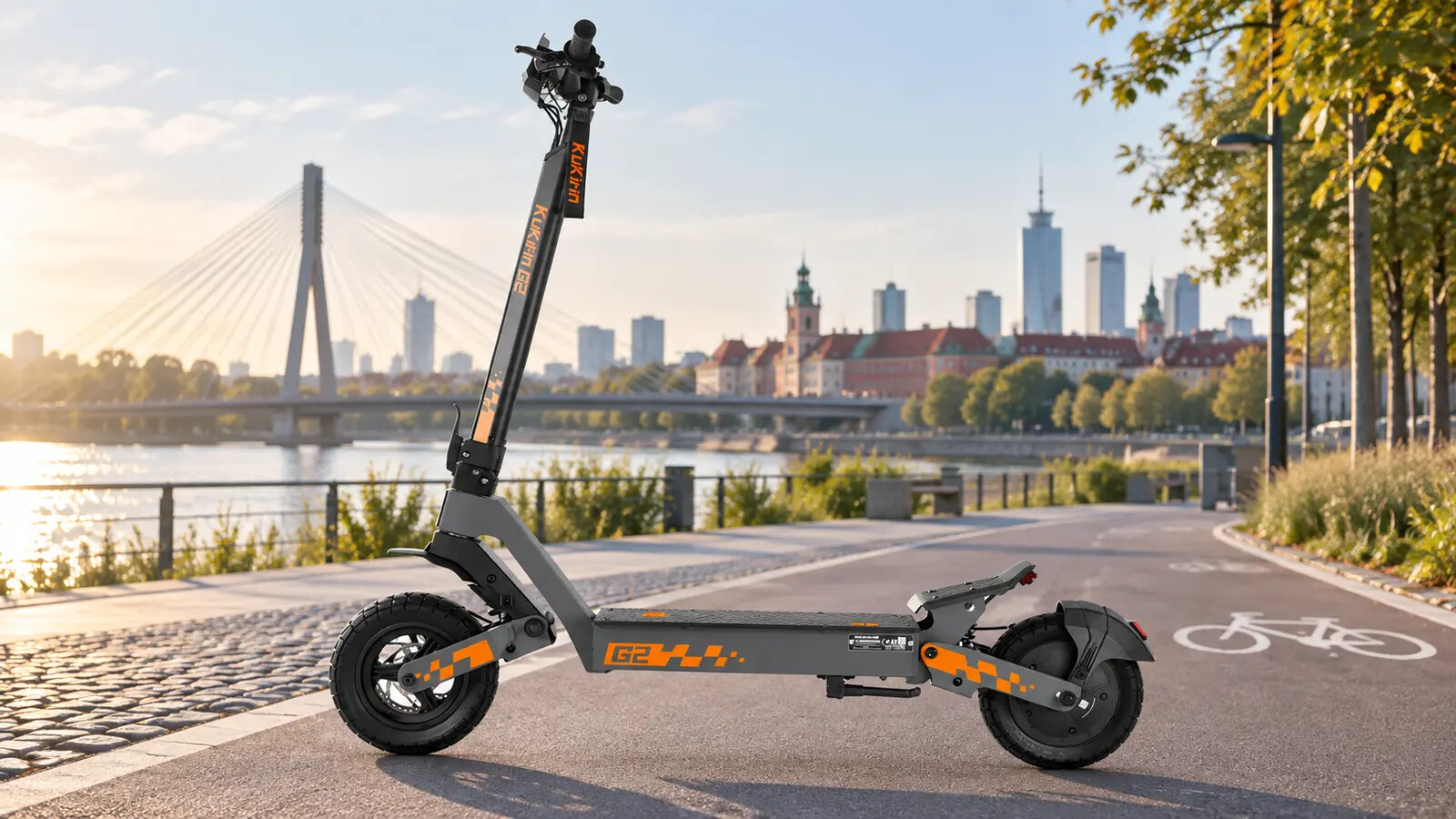
The single rear hub and compact frame keep propulsion visually concentrated. Adding a second motor would change the ownership equation, so this layout suits riders whose normal route already fits the 800W mission.
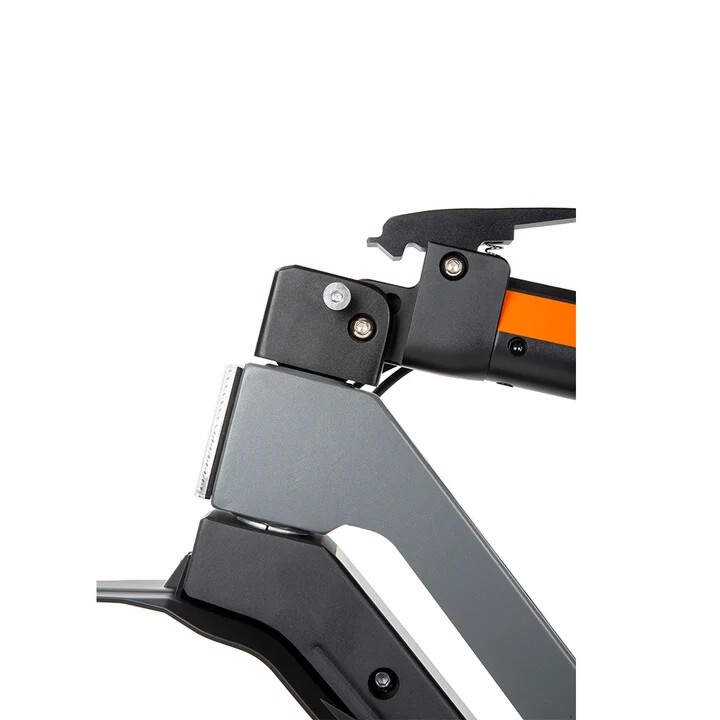
The Hinge Serves Storage
The reinforced folding joint lowers the stem without pretending the scooter is carry-first. It preserves a full-size riding structure while helping buyers fit G2 into a garage, office corner or suitable vehicle.
G2 earns its place through balance. The motor provides useful route margin, the 48V battery supports trips beyond the last mile, and the lower listed weight reduces the penalty each time the scooter must be moved manually.
Choose it when the expected ride is demanding enough to outgrow a basic commuter but not demanding enough to make a second motor productive. See the full KuKirin G2 review for a deeper ownership analysis.
Check Current Deal >>KuKirin G2 Master: The Dual-Motor Route Solver
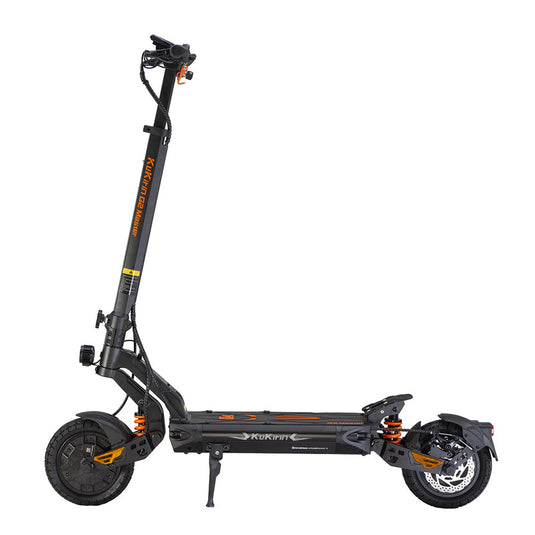
Two Axles Share the Work
Motors at both wheels distribute propulsion across two contact patches. Removing the front drive would erase the Master’s reason for existing, so this architecture rewards gradients, load and repeated acceleration.
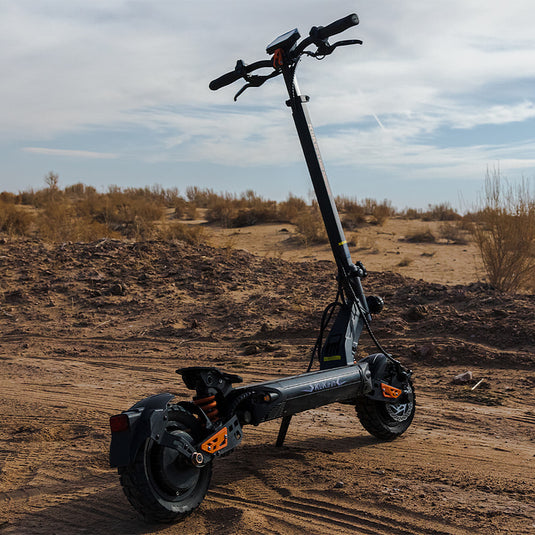
The Chassis Supports Output
Pneumatic tires, suspension and ground clearance form the physical bridge between motor output and uneven ground. Without that support, larger power figures would add less usable control for demanding routes.
G2 Master is not simply G2 with larger numbers. Its product mission changes from balanced mobility to preserving response under resistance. The 52V system, larger battery and two motors work as one package.
Choose it when the route can use that package repeatedly and storage does not require lifting. The KuKirin G2 Master review explains the platform in more detail.
Check Current Deal >>Should You Buy Both?
For one rider, usually not. G2 and G2 Master cover overlapping transport jobs, so owning both often duplicates charging, tire care, storage and security requirements.
Choose the platform that matches the hardest recurring route condition.
Two scooters make sense only for a household with separate rider profiles: one person needs G2’s easier handling and balanced output, while another has the experience, storage and terrain to use G2 Master. The purchase then expands access rather than duplicating performance.
Current KuKirin Code
The current code and eligible products can change. Decide which drive architecture fits first, then use the maintained Store Page to reveal the code and confirm the deduction.

Final Verdict
Buy KuKirin G2 when ownership balance is the priority. It gives everyday riders the useful step into full-size suspension, pneumatic tires and an 800W motor while remaining substantially easier to reposition than G2 Master.
Buy KuKirin G2 Master when dual-motor capability has a defined job. Gradients, heavier loads and repeated acceleration can justify the 52V system, larger battery and extra mass.
If those conditions are absent, G2 leaves less hardware waiting to be used.
Check current model eligibility and the maintained shopping path on the KuKirin Store Page.
KuKirin G2 vs G2 Master FAQs
Who should buy the KuKirin G2?
Choose the KuKirin G2 when an 800W rear motor, a 48V 15Ah battery and up to 55 km of listed range cover the route. It is the more manageable 26 kg platform for mixed commuting and leisure use.
Who should buy the KuKirin G2 Master?
Choose the G2 Master when repeated gradients, heavier loads or stronger acceleration make two driven wheels useful. It uses two 1000W motors, a 52V 20.8Ah battery and lists up to 70 km of range.
What is the main difference between G2 and G2 Master?
G2 is a balanced single-motor scooter. G2 Master is a heavier dual-motor performance platform.
The decision is whether the route repeatedly rewards the Master’s additional traction and response enough to justify its extra mass.
Which model is easier to store and move?
G2 is easier to manage because its listed weight is 26 ± 0.5 kg, compared with 41.5 ± 0.5 kg for G2 Master. Both fold, but neither should be treated as hand luggage.
Does G2 Master always travel farther than G2?
Its listed maximum is higher at up to 70 km versus 55 km, but dual-motor use, speed, gradients, load, temperature and tire pressure can reduce real distance. Route planning should include a reserve.
Can I check the current KuKirin coupon from this comparison?
Yes. Open the CandidCodes KuKirin Store Page to see the maintained coupon, eligible models and current checkout path.
Should I buy both scooters?
Usually no. Their transport role overlaps. Most buyers should choose G2 for balanced ownership or G2 Master for recurring performance demands, then spend the remaining budget on protective equipment, locks and charging access.

CandidCodes may earn a commission from purchases made through sponsored links in this article. Affiliate Disclosure. This does not change the price you pay. Specifications, coupon eligibility, stock and policies should be confirmed before ordering.