🛒 AI Dropshipping Software✓ 7-Day Free Trial📅 Updated for 2026🤖 Ecommerce AI Tools📦 1M+ Product Catalog
✦ Review intent✦ Pricing intent✦ Alternative intent✦ Trial intent
AppScenic Review 2026: AI Dropshipping Tool, Pricing, Free Trial & Ecommerce Automation Features
✍️ CandidCodes Editorial Team📅 Published: May 9, 2026 · Updated: May 21, 2026⏱️ 15 min read🔎 Research-based🔗 Affiliate links
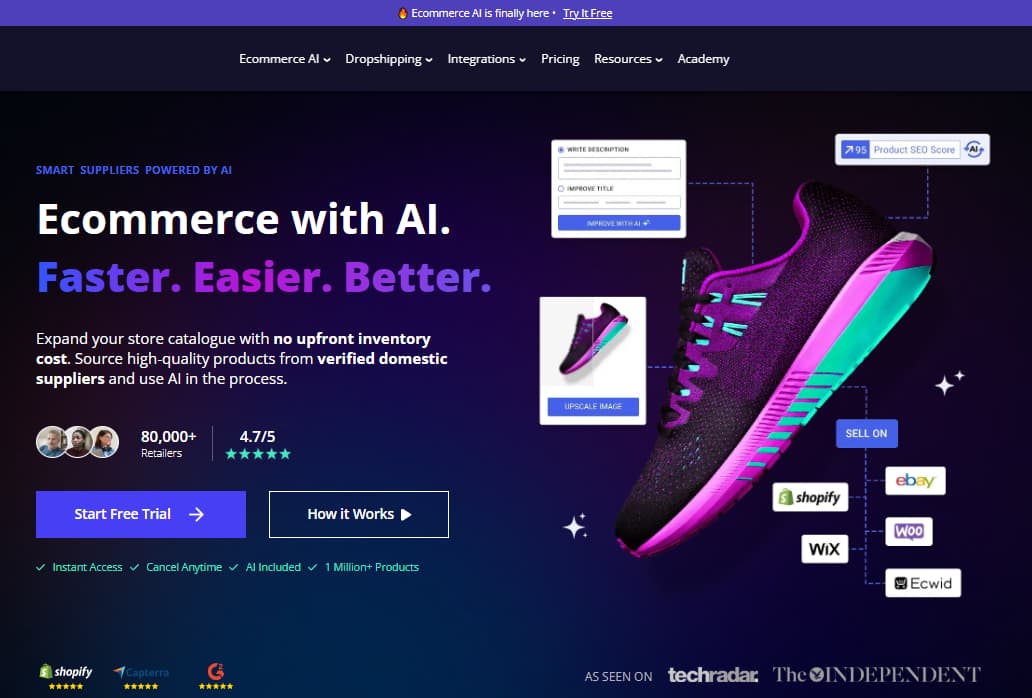
AppScenic is an AI-powered dropshipping and ecommerce automation platform for sellers who want access to supplier catalogs, product import tools, store integrations, AI product content, image upscaling, order automation and stock syncing without manually rebuilding every product page like a tired intern with caffeine debt.
Editorial review method
How CandidCodes evaluated AppScenic
We reviewed AppScenic’s public website, visible pricing screenshots, 7-day trial messaging, monthly and annual plan structure, ecommerce AI feature claims, dropshipping automation use cases, store integration fit, and buyer value for small stores, scaling sellers and ecommerce teams.
AppScenic positions its platform around global dropshipping, ecommerce AI tools and supplier catalog access for online sellers.
Dropshipping tools are useful only when they reduce boring execution: product sourcing, content cleanup, store syncing, order routing and stock updates. AppScenic is strongest when you need supplier access plus ecommerce AI workflow, not when you expect a tool to magically create traffic, margins and taste. Software is not a business model. Annoying, but true.
Quick buyer snapshot
AppScenic verdict table for mobile and desktop
Scroll sideways to read each decision box without crushing the text.
Best for
Small ecommerce stores, Shopify/WooCommerce sellers and dropshippers testing supplier catalogs.
Free trial
7 days, cancel anytime according to the pricing screenshot.
Starting price
Free catalog access or Standard from $39/mo monthly / $31/mo annual view.
Best feature
Ecommerce AI tools + product automation + supplier catalog access.
Best plan
Standard for testing, Pro for serious product volume, Elite for advanced sellers.
Watch out for
Free plan is limited and paid value depends on product volume, traffic and supplier fit.
Swipe or scroll horizontally →
Best current offer
Start with AppScenic’s 7-day free trial
Cancel anytime · Monthly and annual plan options · Annual view shows up to 33% off on Elite · More deals →
✓ No Code Needed
Pricing
AppScenic pricing & plans 2026
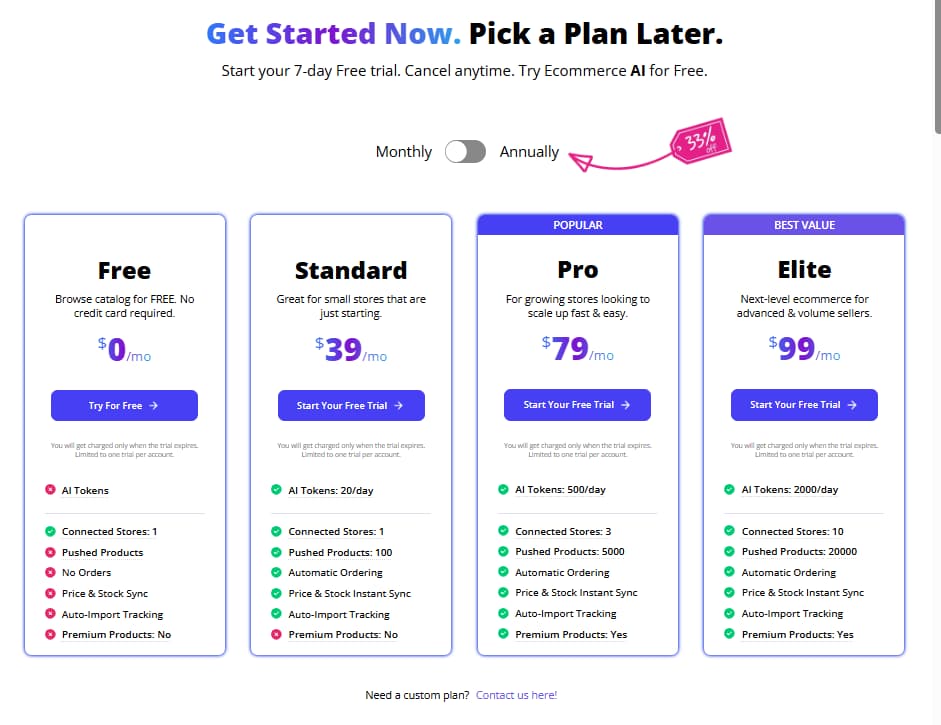
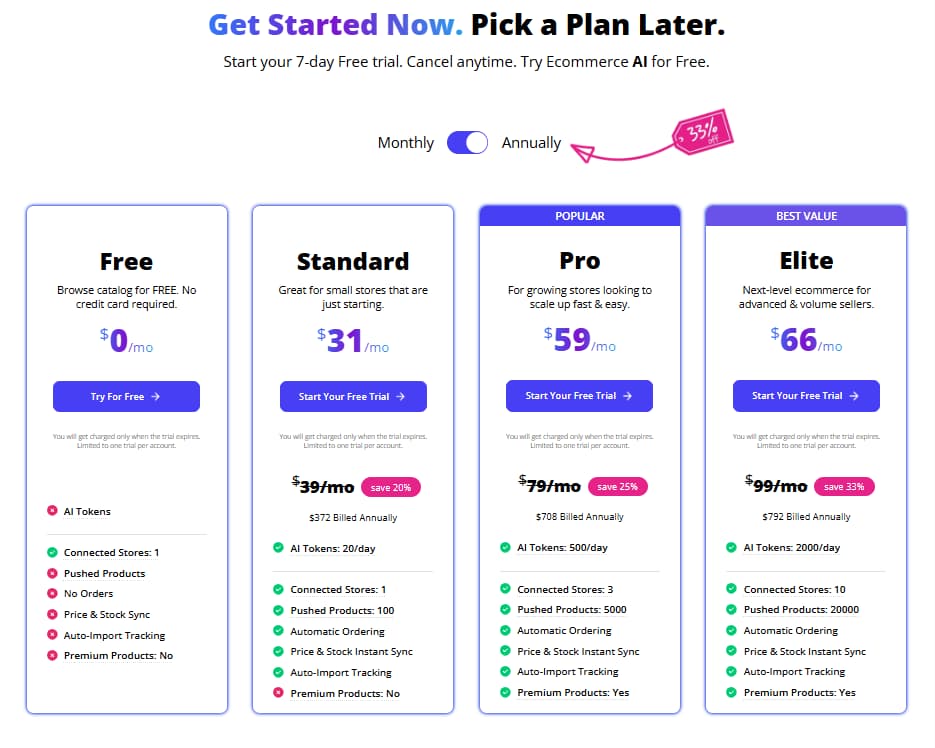
AppScenic pricing is plan-based. The screenshots reviewed by CandidCodes show a Free catalog plan, a Standard plan for small stores, a Pro plan for growing stores, and an Elite plan for advanced sellers. Monthly pricing shows Standard at $39/mo, Pro at $79/mo and Elite at $99/mo. The annual view shows Standard at $31/mo billed annually, Pro at $59/mo billed annually and Elite at $66/mo billed annually.
AppScenic monthly pricing shows a Free plan, Standard at $39/mo, Pro at $79/mo and Elite at $99/mo, with a 7-day free trial available before paid billing starts.AppScenic annual pricing shows discounted monthly-equivalent rates: Standard from $31/mo, Pro from $59/mo and Elite from $66/mo when billed annually.
Pricing context
The useful way to read AppScenic pricing is not just monthly price. The practical difference is AI tokens, connected stores, pushed products, automatic ordering, instant price and stock sync, auto-import tracking and premium product access. Free is for browsing. Standard is for testing one store. Pro and Elite matter when volume stops being cute.
Pricing snapshot
Monthly vs annual pricing for AppScenic paid plans
Scroll sideways to compare plans. Each column is intentionally wide so the text does not get chopped into sad little word confetti.
Plan
Standard$39/mo monthly
PopularPro$79/mo monthly
Best valueElite$99/mo monthly
Annual view
$31/mo · $372 billed annually · save 20%
$59/mo · $708 billed annually · save 25%
$66/mo · $792 billed annually · save 33%
Best fit
One small store that wants to test product import, automation and ecommerce AI without higher-volume costs.
Growing stores that need more AI tokens, more connected stores, higher pushed-product volume and premium product access.
Advanced ecommerce sellers managing more products, more connected stores and more AI-assisted catalog work.
⚠️ Pricing in this review is based on the screenshots provided for this article. Confirm the final plan price, billing cycle, annual total, trial terms, AI token limits, pushed product limits and connected store limits on AppScenic before subscribing.
Pricing view detail
Free
Standard
Pro
Elite
Monthly price
$0/mo
$39/mo
$79/mo
$99/mo
Annual price view
$0/mo
$31/mo billed annually
$59/mo billed annually
$66/mo billed annually
AI tokens
Not included
20/day
500/day
2000/day
Connected stores
1
1
3
10
Pushed products
Not included
100
5000
20000
Premium products
No
No
Yes
Yes
Comparison · Alternative intent
AppScenic vs Spocket vs Syncee
AppScenic should be compared against ecommerce sourcing and dropshipping workflow tools, not generic AI writing tools. The right question is not “which app has the loudest homepage?” It is whether the tool helps you source products, clean up listings, sync store data and process orders with less operational mess.
Feature
AppScenic
Spocket
Syncee
Primary focus
Ecommerce AI + dropshipping automation
Supplier marketplace
Product sourcing marketplace
AI product content tools
Strong focus
Varies by workflow
Varies by workflow
Product image upscaling
Yes, promoted as part of Ecommerce AI
Less central
Less central
Store integrations
Shopify, WooCommerce, Wix, Ecwid, Walmart and more
Common ecommerce platforms
Common ecommerce platforms
Automation angle
Orders, product sync, price and stock workflow
Product import and supplier workflow
Catalog import and product sync
Best for
Sellers who want sourcing plus AI listing workflow
Stores prioritizing supplier discovery
Stores building curated product catalogs
🔄
Need product research before importing listings? Pair AppScenic with FindNiche for ecommerce product research or SEOWriting.ai if you need SEO content for product reviews and category pages.
Features · Operational use cases
Key AppScenic features — with real workflow context
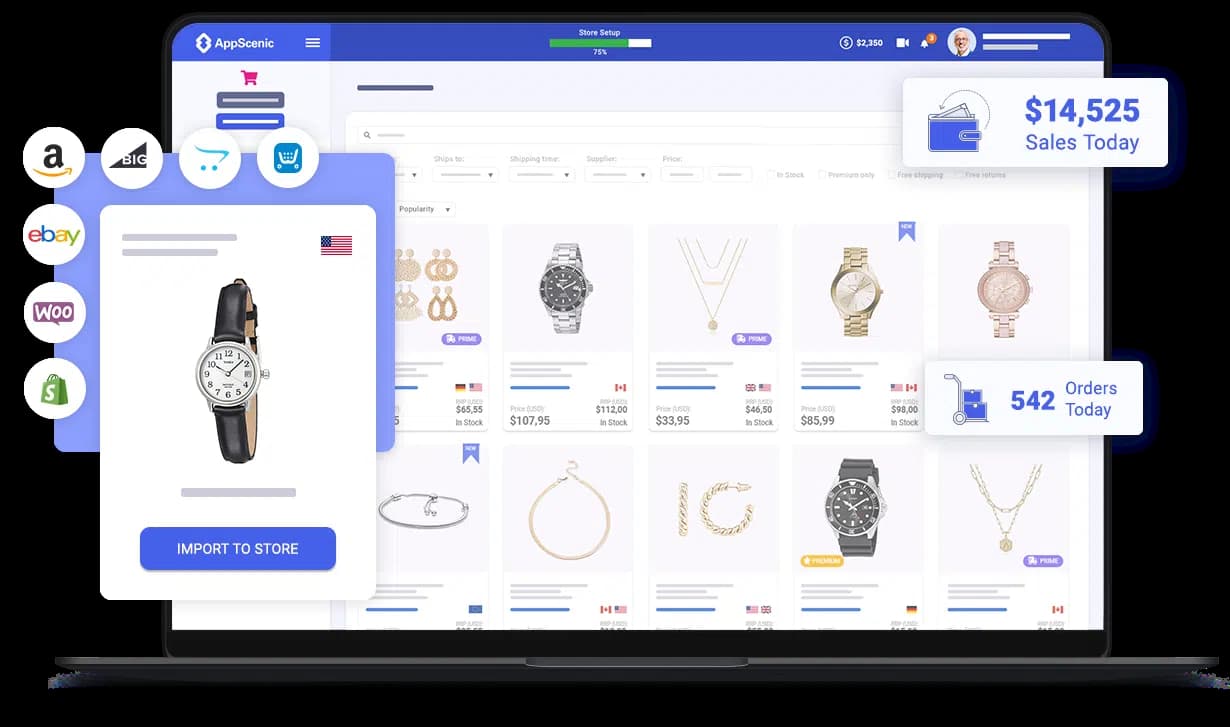
AppScenic combines product catalog access, store integrations and import-to-store automation for ecommerce sellers.
📦
Product catalog and domestic suppliers
AppScenic promotes access to a large dropshipping product catalog and domestic suppliers across major regions such as the USA, UK, EU and Canada. This helps sellers test products without holding upfront inventory.
Use caseBest for a Shopify or WooCommerce seller who wants to test multiple product categories before committing to one supplier relationship.
✍️
AI titles and product descriptions
AppScenic highlights AI tools for improving product titles and descriptions, including ChatGPT-powered workflows. This is useful when supplier copy is thin, repetitive or written with the elegance of a shipping label.
Use caseUseful when importing many products and needing cleaner titles, better descriptions and more consistent product-page messaging.
🖼️
Bulk image upscaling
The platform promotes image improvement and upscaling up to 4X. Better images can help product pages feel more trustworthy, especially when supplier images look like they survived three compression wars.
Use caseGood for stores that need more polished product visuals before pushing items live to a storefront.
🔎
Product SEO optimization
AppScenic includes ecommerce AI tools for product title, description and meta tag optimization. It will not replace a full SEO strategy, but it can clean up product-level SEO faster than manual editing.
Use caseUseful for stores with many imported products where product metadata needs a consistent baseline before content expansion.
⚙️
Order automation and stock syncing
Paid plans in the provided pricing screenshots include automatic ordering, auto-import tracking, and price and stock instant sync. This is where dropshipping software starts to save operational time.
Use caseImportant when orders start coming in and manual supplier updates become a daily punishment ritual.
🔌
Store integrations
AppScenic lists integrations for platforms including Shopify, WooCommerce, Wix, Ecwid and Walmart. That makes it easier to connect product sourcing with the storefront your business already uses.
Use caseStrong fit for sellers who want one sourcing and automation layer connected to an existing ecommerce platform.
⚡ Example: Weekly AppScenic workflow for an ecommerce seller
1
Connect your ecommerce store
Link Shopify, WooCommerce, Wix, Ecwid, Walmart or another supported workflow
2
Browse suppliers and product catalog
Shortlist products based on category, supplier region, pricing and fulfillment fit
3
Improve product listings with Ecommerce AI
Rewrite titles, descriptions, SEO metadata and improve product images before publishing
4
Push products and sync inventory data
Use plan limits for pushed products, store connections, price sync and stock sync
5
Review orders, tracking and product performance
Keep only products that show demand, margin and reliable fulfillment
📌
Building ecommerce content around imported products? Use SEOWriting.ai for affiliate product reviews or Sociamonials if you need contests, referrals and social engagement around campaigns.
Analysis
Pros & cons
✅ What AppScenic does well
✓ Free catalog access is available for browsing before committing to a paid plan
✓ 7-day free trial gives sellers time to test the workflow
✓ Ecommerce AI tools support product titles, descriptions, images and SEO fields
✓ Paid plans include automatic ordering, tracking import and instant price or stock sync
✓ Annual pricing screenshots show meaningful savings on Standard, Pro and Elite
✓ Pro and Elite plans fit sellers with more AI token and product volume needs
⚠️ Limitations to know before buying
! Free plan is mainly for browsing and is limited for real store operations
! Standard does not include premium products according to the screenshot
! The best plan depends heavily on product volume and connected store count
! AppScenic does not replace marketing, ad testing, branding or customer support
! Sellers still need to validate supplier quality, margins and product-market fit
🚫 AppScenic may NOT be the right tool if...
You want a pure SEO platform, not a dropshipping and ecommerce automation workflow.
Your store has no clear niche, traffic plan, product testing process or margin strategy.
You only want to manually manage direct supplier relationships outside a platform.
You sell in policy-sensitive categories and have not checked ads, marketplace and payment rules.
You expect AI and automation to replace basic business judgment. Brave fantasy. Terrible spreadsheet.
Fit assessment
Who should use AppScenic?
Positioning insight
AppScenic sits in the ecommerce operations lane: product sourcing, AI listing improvement, store integrations, order automation and inventory syncing. It is most useful when the seller already has a store strategy and needs a cleaner way to source, publish and manage product data.
✓ Small ecommerce stores
Good fit for sellers testing dropshipping products while keeping startup inventory risk lower.
✓ Shopify and WooCommerce sellers
Useful for sellers who want supplier catalog access, product import workflow and price or stock sync connected to a live storefront.
✓ Growing dropshipping teams
Pro and Elite make more sense when AI tokens, pushed product limits and connected store limits matter.
✓ Ecommerce agencies
Useful for teams helping clients launch or clean up product catalogs, supplier workflows and ecommerce AI listing improvements.
✕ Pure content SEO teams
Use SEOWriting.ai, Surfer, Ahrefs or Semrush if the main job is content planning, backlinks or technical SEO.
✕ Sellers without compliance review
Avoid rushing into restricted or policy-sensitive products without checking ad platform, payment and marketplace rules first.
Final verdict · Review intent
Is AppScenic worth it in 2026?
9.0
Catalog
8.8
AI Tools
8.7
Automation
8.6
Value
8.8
Overall
AppScenic is worth testing if you want a dropshipping platform that combines supplier catalog access, ecommerce AI, product import workflow, order automation, price and stock syncing, and store integrations in one place.
The best plan depends on how serious the store is. Standard is the practical starting paid plan for one small store. Pro is the more balanced pick for growing sellers because it increases AI tokens, connected stores, pushed products and premium product access. Elite is for advanced sellers who need the higher volume shown in the pricing screenshot.
The caveat is simple: AppScenic can help with sourcing and operations, but it will not solve traffic, product positioning, conversion rate, ad economics or customer trust by itself. Those parts still require an operator with a brain, which remains unfair but apparently mandatory.
🧠
Need broader ecommerce workflow support? Compare AppScenic with FindNiche for product research or SEOWriting.ai for product review and roundup content production.
FAQ · Review + pricing intent
Frequently asked questions
Yes. The provided pricing screenshot says AppScenic offers a 7-day free trial and that users can cancel anytime. The Free plan also shows $0/mo for browsing the catalog. Always confirm checkout and billing terms before starting.
The monthly screenshot shows Free at $0/mo, Standard at $39/mo, Pro at $79/mo and Elite at $99/mo. The annual screenshot shows Standard at $31/mo billed annually, Pro at $59/mo billed annually and Elite at $66/mo billed annually.
AppScenic is used for ecommerce AI, dropshipping product sourcing, supplier catalog browsing, product importing, AI product listing improvement, image upscaling, order automation, tracking import, and price or stock sync.
Yes. AppScenic lists store integrations including Shopify and WooCommerce, making it useful for sellers who want to connect product sourcing and automation with an existing ecommerce store.
No. AppScenic helps with sourcing, AI product content, catalog workflow and automation. It does not replace traffic strategy, paid ads, email marketing, conversion optimization or customer support.
Standard is best for one small store testing the platform. Pro is better for growing sellers that need more AI tokens, more connected stores, premium products and higher pushed-product limits. Elite is best for advanced sellers needing the highest limits shown in the pricing screenshot.
Start the 7-day free trial, connect your store, browse products, test the Ecommerce AI tools, review the plan limits and decide whether the workflow saves enough sourcing and operations time to justify the paid plan.