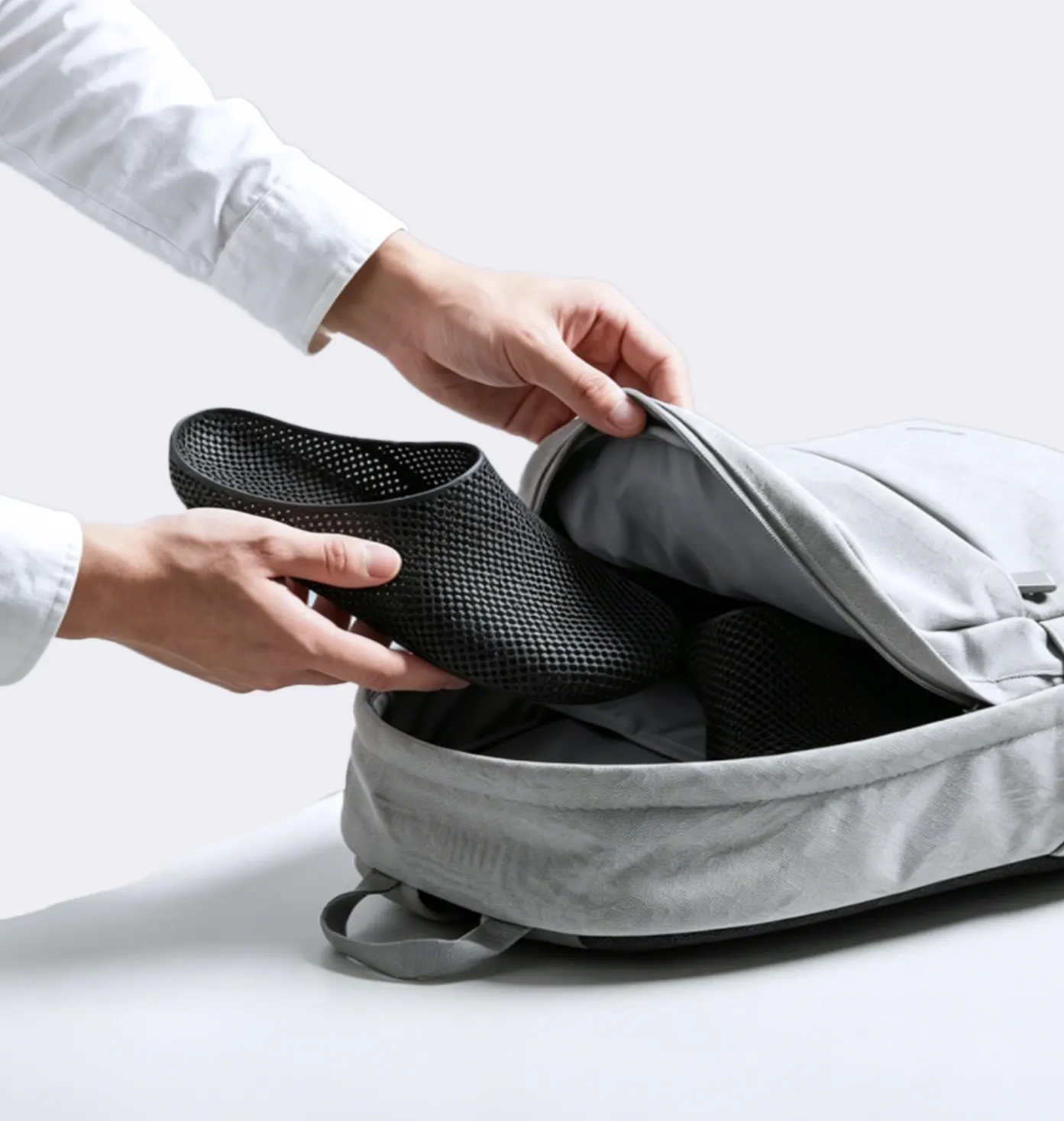
 Nexbie Cloud is built for the part of a journey that ordinary sneakers handle badly: packing small, changing quickly and moving between dry rooms, pool areas, showers and casual outdoor spaces without carrying a second bulky shoe.
This is not a walking sneaker with fewer parts. It is a travel-transition slipper: more enclosed than an open slide, more breathable than a fabric house slipper and easier to pack than conventional foam footwear. That is the job against which every feature should be judged.
The Product Mission: One Pair for Everything Between the Main Events
A product earns a place in your luggage only when it performs a job your primary footwear cannot. Your sneakers carry the long walk, airport connection or city tour. Cloud takes over when that structure becomes unnecessary but going barefoot or wearing an open slide feels too exposed.
The closed toe creates a more useful boundary between the foot and unfamiliar hotel floors, campsite debris or cool corridors. The heel remains easy to enter, while the perforated body gives heat, water and loose sand routes through the slipper rather than trapping them inside layered fabric.
PACK LESS.
DRY FASTER.
FEEL AT HOME ANYWHERE.
That is Cloud's core promise. It does not try to be the most supportive shoe in the suitcase. It tries to become the second pair you actually use often enough to justify packing.
Who Gets the Most Value From Cloud?
Hotel and resort travelers
One pair can cover the room, corridor, pool deck and other short transitions, reducing the need to pack separate indoor slippers and shower slides.
Campers and van travelers
Cloud removes the repeated task of fastening hiking shoes whenever you step outside briefly, while keeping the toes more enclosed than a slide.
Pool and beach users
The open lattice lets water and loose sand leave through the structure instead of remaining inside an absorbent upper.
Home users in warm climates
A dedicated indoor pair separates outdoor footwear from the living space without wrapping the foot in a heat-holding fabric slipper.
If your day is defined by distance, speed or long periods of standing, Cloud is not the lead product. It becomes valuable when the day contains many short movements and repeated footwear changes. The more often those small transitions occur, the more useful a lace-free, quick-draining pair becomes.
Why the 3D-Printed Lattice Changes the Use Case
Traditional slippers usually create comfort by adding foam, fabric and lining. That approach can feel soft, but every added layer introduces somewhere for heat, water, odor and sand to remain. Cloud creates much of its form through an open one-piece lattice instead.
Nexbie states that Cloud uses an 80% open lattice structure. In practical terms, ventilation is distributed across the slipper rather than being limited to the ankle opening. In a humid hotel room, after a shower or following a day in enclosed sneakers, the foot has far more exposure to moving air.
The same geometry supports drainage. A wet fabric slipper waits for water to travel through absorbent material. Cloud gives it direct openings. That makes cleaning, rinsing and returning the pair to use more practical during multi-day travel.
Cloud-Flex Cushioning: Comfort Without Packing a Bulky Midsole
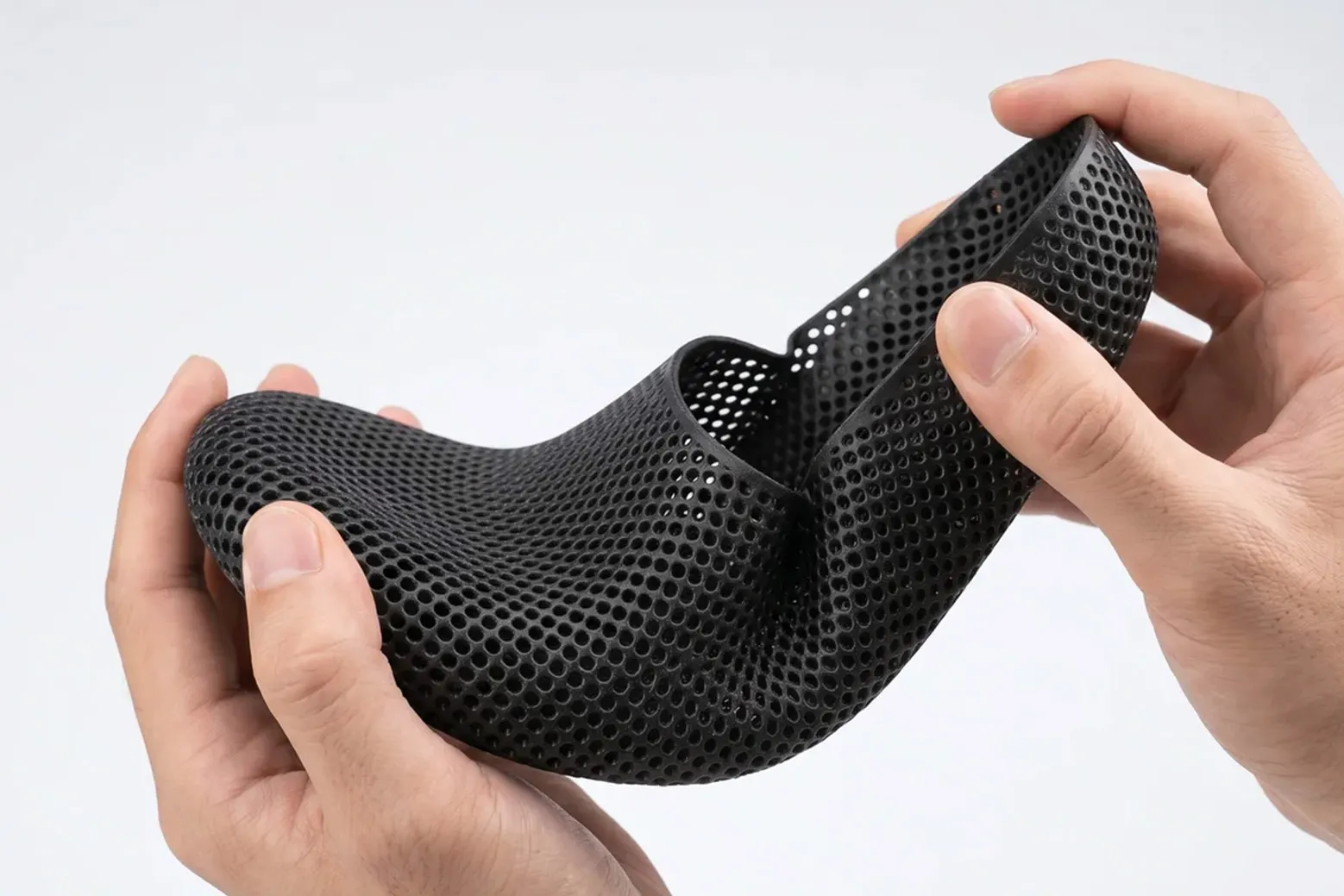
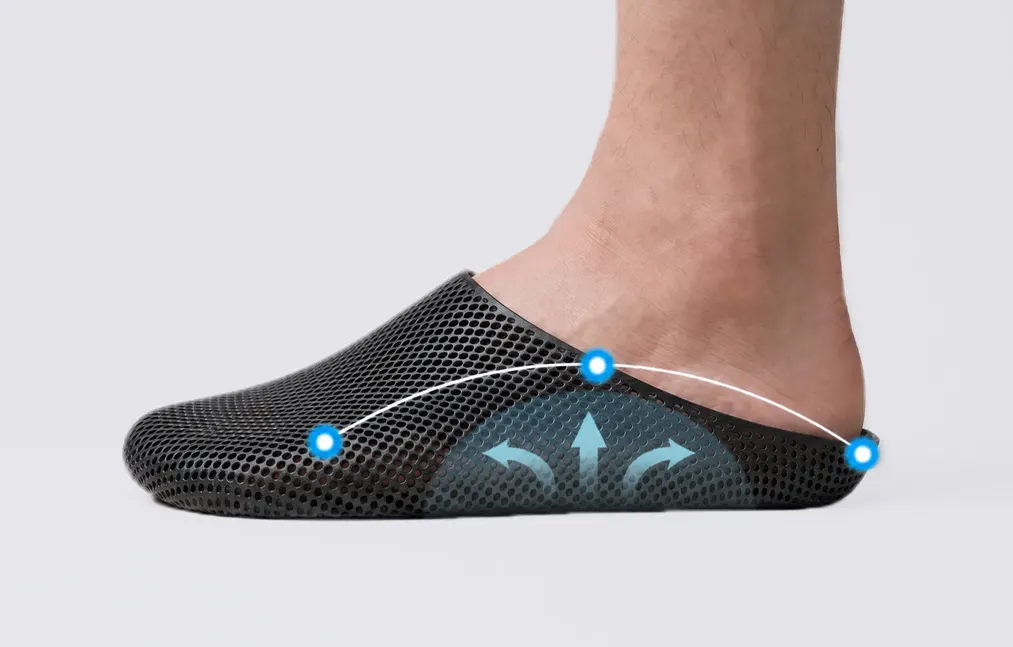
Nexbie describes the engineered heel as pressure-relieving cushioning with controlled give. The buyer benefit is not simply that the material feels soft.
A compliant lattice can deform under load and recover its shape without requiring the thick blocks of conventional foam that make many recovery shoes awkward to pack.
Think about when Cloud is likely to be worn. After a flight, a city walk or several hours in work shoes, you are not asking the slipper to propel a fast stride. You want an easier platform for the lower-intensity part of the day.
The cushioning is therefore serving decompression and casual movement rather than athletic performance.
The closed forefoot adds another layer of value. It gives toes a defined space and helps Cloud feel more appropriate in hotel corridors, shared accommodation and casual nearby errands than a completely open shower slide.
Quick-Dry and Sand-Release Design
Wet footwear becomes a travel problem after the water event has ended. Fabric uppers hold moisture against other luggage, enclosed footbeds collect sand and slow-drying foam may still feel damp when you need to pack.
Cloud's openings allow water and particles to escape throughout the body. At the pool, you can rinse chlorinated water rather than letting it remain inside an absorbent lining.
At the beach, loose sand has multiple paths out instead of collecting beneath a fixed insole. During rain, the product is intended to drain rather than keep the foot dry.
That last distinction matters: quick-draining is not waterproof. Cloud is useful because it accepts wet conditions and recovers from them more logically. It is not designed to prevent water from reaching the foot.
Odor Control Matters More on a Multi-Day Trip
Nexbie positions the lattice as antimicrobial and odor-resistant. The useful scenario is repeated wear with limited drying and washing facilities—the exact conditions that make conventional travel slippers unpleasant before the trip ends.
The open construction reduces the warm, enclosed environment in which odor can build, while the one-piece design removes glued fabric layers that are difficult to rinse thoroughly.
This does not eliminate basic care. Rinse after saltwater or pool use, remove visible debris and let the pair dry in open air before placing it in a closed bag.
Shape Retention Turns Flexibility Into Long-Term Utility
A packable slipper must flex without becoming disposable. Nexbie describes Cloud as shape-retaining and durable, which is important because luggage repeatedly bends, compresses and rubs footwear against other items.
The one-piece printed form also reduces dependence on glued seams between an upper, footbed and outsole.
Fewer joined sections mean fewer interfaces that can separate after repeated wetting and drying. This does not prove unlimited durability, but it explains why the manufacturing method fits the product's travel mission.
Nexbie Cloud vs Traditional Slippers
| Decision point | Nexbie Cloud | Traditional fabric or foam slipper | Why it matters |
|---|---|---|---|
| Packing | Flexible, lightweight one-piece form | Often relies on thick foam or padded fabric | Cloud is easier to justify when luggage space is limited. |
| Ventilation | Open lattice across most of the body | Air mainly enters through the foot opening | Distributed airflow better suits heat and repeated wear. |
| Water | Openings release water directly | Fabric and foam may retain moisture | Cloud can return to use sooner after wet-area contact. |
| Sand and debris | Particles have multiple exit paths | Debris can collect beneath the foot | Rinsing is simpler after beach or campsite use. |
| Assembly | One-piece printed structure | Commonly uses several glued or stitched layers | There are fewer joined sections exposed to wet-dry cycles. |
| Coverage | Closed toe with easy-entry heel | Varies from open slide to fully lined slipper | Cloud balances quick entry with more front-foot enclosure. |
Cloud vs AeroCloud: Similar Material, Different Mission
AeroCloud is the better recovery slide when you want the fastest entry and maximum openness.
Cloud is the better travel slipper when the same trip includes indoor floors, cooler spaces, shared accommodation or short movements where covered toes feel more appropriate.
Do not choose between them by appearance alone. Ask which inconvenience you want to remove.
If bending down, changing quickly after exercise and leaving the toes free matter most, start with AeroCloud. If a single compact pair must cover more environments, Cloud has the broader travel role.
Fit, Sizing and the One Check That Protects the Purchase
A flexible upper can accommodate movement, but it cannot correct the wrong length. Your toes should sit inside the closed front without pressing into it, and the heel should not travel excessively during a normal step.
Measure both feet and use the current Nexbie size chart. If you plan to wear socks in hotels or cooler accommodation, measure with that sock thickness. Buyers between sizes should follow the brand's current guidance and review return eligibility before treating a discount as the deciding factor.
What to Consider Before Buying
Cloud is purpose-built for travel, home, wet areas and casual transitions. It is not the Nexbie model for long-distance walking, demanding trails or activities that require a secured heel.
The lattice drains water because it allows water through, so it should not be confused with waterproof footwear.
Nexbie currently lists free shipping, a 30-day money-back guarantee and lifetime customer support on the supplied product page.
Confirm the live conditions before ordering; lifetime support should not be interpreted as a lifetime product warranty unless the current policy states that separately.
Is Nexbie Cloud Worth Buying?
Yes—when you buy it for its designed role. Cloud earns its price by replacing several weak travel compromises: barefoot movement on unfamiliar floors, open slides with limited coverage, fabric slippers that retain water and a second pair of sneakers that consumes valuable packing space.
The strongest buyer is not looking for one shoe to do everything. They already have footwear for the main activity and want the hours around that activity to become easier.
Cloud supplies that missing layer: compact enough to carry, enclosed enough to use in more places and open enough to handle heat and water.
Check the current Nexbie Cloud offer and eligible checkout conditions.
Related Nexbie Reviews
Frequently Asked Questions
What are Nexbie Cloud Slippers designed for?
Cloud is designed for travel, accommodation, home routines and wet-to-dry transitions. Its role is to provide more coverage than an open slide without the bulk and moisture retention associated with many traditional slippers.
Are Nexbie Cloud Slippers waterproof?
No. The open lattice is designed to drain water, not block it. That makes Cloud relevant around pools, showers and rain, but the foot will still become wet.
Can Cloud replace a walking sneaker?
Cloud is better treated as a travel-transition slipper. Aeroraise or Aeriscape is the more logical Nexbie format when long walking distances and secure sneaker coverage are the priority.
What does 80% open lattice mean for the buyer?
It means much of the structure contains openings that support distributed airflow, drainage and particle release. The practical benefits are cooler wear, easier rinsing and less retained water or sand.
How should Cloud Slippers be packed after water use?
Rinse away chlorine, salt or debris, then let the pair drain and air-dry before placing it in closed luggage. A quick-draining structure still needs ventilation before storage.
Where can I check the current Nexbie discount?
See the CandidCodes Nexbie Store Page for the maintained offer and eligible products. Confirm the final price and conditions at checkout.
Editorial basis: this analysis uses the product specifications and images supplied from Nexbie. It does not claim hands-on testing or medical benefit.